By Timeswatch

Writ of Possession executed in Arochukwu ends one of Nigeria’s longest-running land cases — first decided in 1949, eleven years before independence.
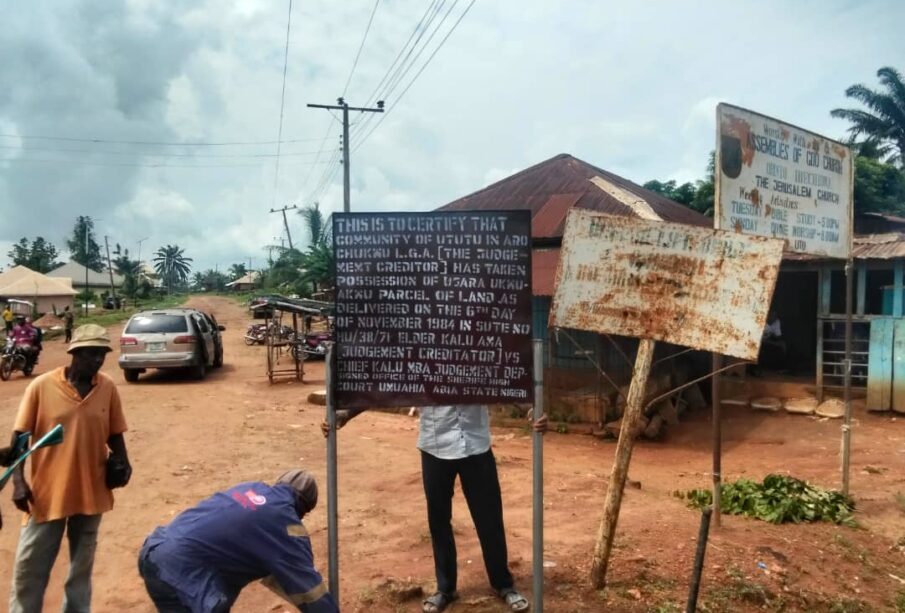
UMUAHIA/AROCHUKWU — Officers of the High Court of Abia State are executing a Writ of Possession handing the vast Ujara Ukwuakwu farmland in Ututu, Arochukwu Local Government Area, to the Ukwuakwu community — bringing to a close a title dispute that has run, without interruption, since 1949.
The execution follows the Order of Hon. Justice C. Chido Nwakanma of 20 May 2025 in Suit No. HU/66M/2025, which granted leave to the Registrar of the High Court, Umuahia, to issue the writ in enforcement of the judgment of 6 November 1984 in the consolidated Suits Nos. HU/38/71 and HU/45/71. The formal Warrant for Possession was signed and sealed on 28 May 2025.
The 1984 judgment, delivered by Hon. Justice Amadi-Obi of the High Court, Umuahia, declared title to the land in favour of the Ukwuakwu community of Ututu against the Obinto community of Ihechiowa, awarded damages for trespass, ordered possession, and imposed a perpetual injunction. The Court of Appeal, Port Harcourt, dismissed appeals by both sides on 11 January 1991, and no appeal was taken to the Supreme Court.
Court records show the dispute was first decided on 28 September 1949, when the Ututu Native Court, presided over by Squadron Leader R.A. Clarke, D.F.C., dismissed the rival claim and awarded title to Ukwuakwu. Subsequent enforcement rulings in 2002 and 2003 — by Justices S.O.E. Nwanosike and C.I. Jombo-Ofo, and the Court of Appeal per Akintan, Presiding Justice — cleared every objection raised against execution.
“Our fathers began this journey in 1949 and did not live to see this day,” said HRM Eze Michael Ogbonnaya Eke, Eze Ogo Ukwuakwu Ututu, in a statement. “For seventy-seven years we chose the courtroom over confrontation. Today the law has kept its promise.”
Engr. Kalu Okore Nto, President General of the Ukwuakwu Ututu Development Association (National), urged calm and cooperation with court officials: “We enjoin all our people to remain law-abiding, orderly and peaceful. This possession belongs to due process, and it will be conducted with the dignity of due process.” [Quote to be confirmed by speaker before publication.

The community said the doors of “lawful, voluntary neighbourliness” remain open to the Obinto community, and that certified true copies of all judgments and orders — from the 1949 Native Court decision to the 2025 warrant — are available for public verification.
Legal observers describe the case as one of the longest continuously litigated land matters in Nigerian judicial history, spanning the colonial Native Court system, the post-independence High Courts, the Court of Appeal, and modern enforcement procedure under the Judgments (Enforcement) Rules.